
June 2026 Newsletter | Tax, Accounting & Business Advisory Insights
JUNE 2026 NEWSLETTER
A Word from Our CEO
In this edition, we bring together three important themes that reflect the realities of running and managing a business: understanding your tax position, knowing what to expect from your professional accountant, and making informed decisions when it is time to formally close a business through voluntary deregistration.
At first glance, these topics may seem unrelated. In practice, they are deeply connected.
Choosing the appropriate income tax structure—whether it be the standard corporate tax system, Small Business Corporation (SBC) regime, or turnover tax—is not simply a compliance exercise. It is a strategic decision that influences cash flow, profitability, and the long-term sustainability of your business. Making the right choice requires not only technical knowledge, but also a clear understanding of your business model and growth plans.
This is where the role of a professional accountant becomes critical. A competent accountant does more than ensure compliance—they provide clarity, foresight, and guidance. They help translate complex regulations into practical decisions, support you in navigating tax obligations, and ensure that your financial position is accurately reflected at all times. As business environments become more complex, the value of having a trusted financial advisor cannot be overstated.
Equally important is recognising when it is time to close a chapter. Voluntary deregistration, when handled correctly, is a responsible and structured way to exit a business that is no longer active or viable. It reflects sound governance and protects both the business owner and stakeholders from future complications. A well-managed exit is not a sign of failure, but rather a demonstration of discipline and professionalism.
Across all these areas, one principle remains constant: informed decision-making is the foundation of business success. Whether you are selecting a tax regime, engaging with your accountant, or considering deregistration, the quality of your decisions will determine your outcomes.
At our firm, we are committed to supporting our clients at every stage of their journey—from establishing the right financial structures, to maintaining compliance, and, where necessary, guiding them through a structured exit. Our goal is to ensure that every decision is made with confidence, clarity, and a long-term perspective.
We encourage you to reflect on your current position:
- Are you operating under the most suitable tax structure?
- Are you receiving the level of insight and support you need from your accountant?
- Are all aspects of your business aligned with your long-term objectives?
By addressing these questions proactively, you position your business not only for compliance, but for resilience and sustained success.
Let us continue building businesses that are well-managed, well-advised, and prepared for every stage of the journey.
ACCOUNTING
What clients should expect from a Professional Accountant
Engaging a professional accountant is one of the most important decisions a business owner can make. Beyond compliance and number-crunching, a professional accountant plays a critical role in safeguarding financial integrity, supporting strategic decisions, and contributing to long-term business success.
However, many clients are unsure of what they should reasonably expect from this relationship. Setting clear expectations not only improves service delivery but also ensures a productive and value-driven partnership.
The role of a Professional Accountant
A professional accountant is responsible for more than preparing financial statements or submitting tax returns. Their role typically spans compliance, advisory, financial management, and risk mitigation.
For clients, this means gaining access to both technical expertise and strategic insight.
Key expectations clients should have
1. Accuracy and attention to detail
Financial information must be accurate, reliable, and prepared in accordance with applicable standards and regulations.
Clients should expect:
Material error-free financial records.
Proper classification of transactions.
Compliance with reporting frameworks.
Accuracy is non-negotiable—it forms the foundation of all financial decision-making.
2. Timely service delivery
Meeting deadlines is critical in accounting, particularly for tax submissions, payroll, and statutory filings.
Clients should expect:
Adherence to agreed timelines.
Proactive reminders of upcoming deadlines.
Efficient turnaround times.
Delays can result in penalties and unnecessary stress.
3. Strong knowledge of regulations
A professional accountant must stay up to date with evolving legislation and regulatory requirements.
Clients should expect:
Compliance with tax laws and reporting standards.
Guidance on regulatory changes.
Proper application of financial legislation.
This ensures the business remains compliant and avoids legal risks.
4. Clear communication
Accounting information can be complex, but it should always be communicated in a way that clients can understand.
Clients should expect:
Simple explanations of financial reports.
Transparency regarding fees and processes.
Open and responsive communication.
A good accountant translates numbers into meaningful insights.
5. Proactive advice and insight
Beyond compliance, a professional accountant should add value through strategic input.
Clients should expect:
Tax planning and optimisation strategies.
Cash flow management advice.
Financial forecasting and budgeting support.
The goal is not just to report on the past, but to help shape the future.
6. Confidentiality and professional ethics
Accountants handle sensitive financial information and must uphold strict ethical standards.
Clients should expect:
Confidential handling of all financial data.
Integrity and independence.
Professional conduct at all times.
Trust is central to the client-accountant relationship.
7. Tailored services
Every business is unique, and accounting services should reflect that.
Clients should expect:
Solutions aligned with their business size and industry.
Flexibility as the business evolves.
Personalised support rather than a one-size-fits-all approach.
What clients should also bring to the relationship
While expectations of accountants are important, a successful partnership is mutual. Clients should:
Provide accurate and timely information.
Respond to queries promptly.
Maintain open communication.
Take an active interest in their financial affairs.
Collaboration enhances outcomes.
Common misconceptions
“Accountants only handle tax.”
In reality, they play a broader advisory and strategic role.“Once I hire an accountant, I don’t need to worry about finances.”
Business owners still need to stay informed and engaged.“All accountants offer the same service.”
The quality, expertise, and approach can vary significantly.
Practical recommendations
Clearly define the scope of services at the outset.
Establish communication channels and expectations.
Schedule regular financial reviews.
Choose an accountant who aligns with your business goals.
Conclusion
A professional accountant is more than a compliance partner—they are a strategic ally in your business journey. By understanding what to expect, clients can build stronger relationships, receive greater value, and make more informed financial decisions.
Ultimately, the right accountant does not just manage your numbers—they help you understand them, use them, and grow from them.
TAXATION
Understanding the different types of income tax in South Africa: A guide for businesses
Income tax is a central component of financial compliance and planning for any business. However, not all businesses are taxed in the same way. South Africa offers different income tax regimes depending on the size, structure, and nature of a business. Understanding these options is essential for ensuring compliance while also optimising tax efficiency.
In this article, we explore the main types of income tax applicable to businesses: the standard corporate tax (flat rate), Small Business Corporation (SBC) tax, and Turnover Tax.
1. Standard Corporate Income Tax (Flat Rate)
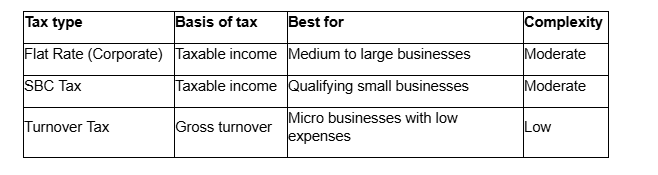
Most companies in South Africa are subject to a flat rate of corporate income tax on their taxable income.
Key features:
A single, fixed tax rate applied to taxable profits.
Applicable to most private companies and larger entities.
Requires submission of annual income tax returns and provisional tax payments.
Who it applies to:
Small, medium to large businesses.
Companies that do not qualify for special tax regimes.
Advantages:
Simplicity in calculation.
No restrictive qualification criteria.
Considerations:
May result in a higher tax burden for smaller businesses compared to preferential regimes.
2. Small Business Corporation (SBC) Tax
The SBC tax regime is designed to support qualifying small businesses through reduced tax rates.
Key features:
Progressive tax rates (lower rates on lower income brackets).
Preferential tax treatment to encourage growth.
Qualification criteria (general):
Must be a qualifying company (not a personal service provider).
Shareholders must generally be natural persons.
Annual turnover and other requirements must fall within prescribed thresholds.
Limits on passive income and investment activities.
Advantages:
Lower tax rates compared to the standard corporate rate.
Cash flow relief for growing businesses.
Considerations:
Strict qualification requirements.
Loss of benefits if criteria are not consistently met.
3. Turnover Tax
Turnover tax is a simplified tax system aimed at micro businesses with relatively low turnover.
Key features:
Tax is calculated on turnover (gross income), not profit.
Simplified record-keeping and compliance requirements.
Replaces several taxes, including income tax, VAT (in most cases), and provisional tax.
Who it applies to:
Micro businesses with turnover below the prescribed threshold.
Sole proprietors, partnerships, companies, and CCs that meet the criteria.
Advantages:
Simplicity and reduced administrative burden.
Predictable tax liability.
Considerations:
May not be beneficial for businesses with high expenses, as tax is not based on profit.
Limited deductions available.
Comparing the tax regimes
Choosing the right tax regime
Selecting the appropriate tax system is a strategic decision. Factors to consider include:
Business size and turnover
Cost structure and profit margins
Growth plans
Compliance capacity
In some cases, what appears simpler (such as turnover tax) may not be the most tax-efficient option.
Common pitfalls
Assuming eligibility without verifying criteria.
Failing to reassess qualification annually.
Overlooking the long-term impact of a tax regime.
Not seeking professional advice when transitioning between regimes.
Practical recommendations
Conduct a tax assessment annually to determine the most suitable regime.
Keep accurate financial records regardless of the system used.
Monitor qualification criteria closely, especially for SBC and turnover tax.
Seek professional guidance before making changes.
Conclusion
South Africa’s income tax framework provides flexibility for businesses at different stages of growth. Whether operating under the standard corporate tax system, benefiting from SBC rates, or opting for turnover tax, the key lies in understanding the implications of each option.
By choosing the right tax regime and managing it effectively, businesses can not only remain compliant but also enhance their financial sustainability and growth potential.
BUSINESS ADVISORY
Voluntary deregistration of companies and Close Corporations (CCs): process, requirements and key considerations
Voluntary deregistration is a formal process that allows a registered company or Close Corporation (CC) to be removed from the official register (CIPC) when it is no longer required. For business owners looking to close a dormant or inactive entity, this process provides a cost-effective and compliant way to conclude operations.
However, voluntary deregistration must be approached carefully to avoid future legal, tax, or administrative complications.
What is voluntary deregistration?
Voluntary deregistration occurs when a company or CC applies to be removed from the CIPC register on its own initiative. Once approved, the entity ceases to exist as a legal person and is no longer required to meet ongoing compliance obligations such as annual returns.
When should a business consider voluntary deregistration?
Voluntary deregistration is typically appropriate when:
The entity is no longer trading.
There are no assets or liabilities remaining in the business.
The cost of maintaining compliance outweighs the benefit of keeping the entity active.
The business has fulfilled its purpose (e.g. project-based entities).
It is important to note that deregistration should not be used to avoid debts or legal obligations.
Key requirements for voluntary deregistration
Before applying, the following conditions must generally be met:
1. No assets or liabilities
The company or CC must confirm that it holds no assets and has no outstanding liabilities.
All bank accounts should be closed.
All creditors must be settled.
Any remaining assets should be distributed appropriately.
2. Tax compliance
The entity must be in good standing with SARS. This includes:
Submission of all outstanding tax returns.
Settlement of any tax liabilities.
Confirmation that there are no pending audits or disputes.
3. Cessation of business activities
The entity must no longer be conducting any business or trading activities.
The voluntary deregistration process
Step 1: Prepare supporting documentation
This may include:
A formal request for deregistration.
A statement confirming no assets and liabilities.
Certified identification documents of directors or members.
Step 2: Submit application to CIPC
The application is lodged with the (CIPC), either online or through prescribed forms.
Step 3: SARS verification
CIPC will typically liaise with SARS to verify the entity’s tax compliance status.
Step 4: Publication and final deregistration
Once approved, the entity’s status will be updated to “deregistered,” and it will be removed from the register.
Consequences of voluntary deregistration
Business owners should fully understand the implications:
The entity loses its legal personality.
It can no longer trade or enter into contracts.
Any undisclosed assets may vest in the government.
Bank accounts in the entity’s name will be closed or frozen.
Reinstatement may be required if business needs to resume.
Common pitfalls to avoid
Applying with outstanding liabilities: This may lead to rejection or future disputes.
Overlooking tax compliance: SARS non-compliance can delay or prevent deregistration.
Failing to properly close accounts: Open bank accounts or contracts can create complications.
Using deregistration to avoid debt: This can result in legal consequences for directors or members.
Practical recommendations
Conduct a full financial and legal review before applying.
Ensure all statutory and tax obligations are up to date.
Keep clear records of asset disposal and liability settlement.
Seek professional guidance to manage the process efficiently.
Conclusion
Voluntary deregistration is a practical solution for businesses that have reached the end of their lifecycle. When executed correctly, it provides a clean and compliant exit. However, careful planning and full compliance are essential to avoid unintended consequences.
As always, proactive management and professional support can make the process seamless and ensure that business owners close this chapter with confidence and peace of mind.