July 2026 Newsletter | Bookkeeping, Tax & Business Compliance
Accounting, Taxation, Business Advisory, South Africa 2026
JULY 2026 NEWSLETTER
A structured look at bookkeeping and management accounts, income tax compliance, and the difference between shareholders and directors — with 2026 South African regulatory updates that every business and individual should be aware of.
A Word from Our CEO
At SPJ Accountants, we continue to observe a common theme across many businesses we support: financial success is rarely about effort alone—it is about structure, discipline, and informed decision-making. This edition brings together three important areas that sit at the heart of every sustainable business: bookkeeping and management accounts, income tax compliance, and the distinction between shareholders and directors.
The foundation: bookkeeping and management Accounts
Strong businesses are built on strong financial records. Bookkeeping is not simply about recording transactions; it is about creating a reliable financial story of your business. When this is done correctly, it feeds into meaningful management accounts that allow business owners to understand performance in real time.
Without this foundation, decisions become reactive instead of strategic. With it, business owners gain clarity on profitability, cash flow, and growth opportunities.
The discipline: income tax compliance
Once financial records are in place, compliance becomes the next critical step. Income tax compliance is not optional—it is a legal and financial responsibility that protects your business from penalties and reputational risk.
More importantly, it reflects the discipline of a well-managed business. Submitting accurate returns, maintaining proper records, and meeting deadlines with the South African Revenue Service (SARS) positions your business as credible and investment-ready. Compliance is not just about avoiding problems; it is about building trust in your business operations.
The structure: Shareholders vs Directors
Many businesses struggle not because of poor performance, but because of unclear roles. Understanding the difference between shareholders and directors is essential for proper governance. Shareholders own the business, while directors manage it. When these roles are clearly defined, decision-making becomes smoother, accountability improves, and business risk is reduced. This structure is also essential for compliance with the Companies and Intellectual Property Commission (CIPC).
A well-structured company is far more resilient and better positioned for growth.
Final Thought
When these three elements work together—accurate bookkeeping, strong tax compliance, and clear corporate structure—you create a business that is not only compliant, but also strategically positioned for long-term success. At SPJ Accountants, our mission is to help businesses move beyond survival and into sustainable growth through financial clarity, compliance, and structure.
Till next time,
Spokazi P Jojo
Founder & CEO
ACCOUNTING
Bookkeeping and management accounts: The foundation of sustainable business growth
Running a successful business requires more than generating sales and serving clients. Every business, regardless of size, needs accurate financial information to make informed decisions, remain compliant, and maintain long-term profitability. This is where bookkeeping and management accounts play a critical role.
What Is Bookkeeping?
Bookkeeping is the process of recording, organising, and maintaining a business’s daily financial transactions. These transactions include sales, purchases, expenses, receipts, payments, payroll, and bank transactions. Proper bookkeeping ensures that a business has accurate and up-to-date financial records at all times. It forms the foundation upon which all other financial reporting and analysis are built.
Typical bookkeeping functions include:
Capturing daily transactions
Reconciling bank accounts
Recording invoices and receipts
Managing creditors and debtors
Processing payroll
Maintaining financial records
Preparing VAT-related records
Without proper bookkeeping, businesses may struggle with inaccurate reporting, cash flow problems, missed tax obligations, and poor financial decision-making.
What are management accounts?
Management accounts are financial reports prepared periodically — usually monthly or quarterly — to help business owners and management evaluate the financial performance of the business. Unlike annual financial statements, which are often prepared mainly for compliance purposes, management accounts are designed to support strategic decision-making throughout the year.
Management accounts typically include:
Profit and loss statements
Balance sheets
Cash flow reports
Budget comparisons
Financial performance analysis
Key financial ratios and insights
These reports provide business owners with a clear picture of how the business is performing financially and operationally.
Why bookkeeping and management accounts matter?
Better decision-making
Accurate financial information enables business owners to make informed decisions about pricing, staffing, expansion, investments, and operational costs. Without reliable financial data, decisions are often based on assumptions rather than facts.Improved cash flow management
Many profitable businesses still experience cash flow difficulties due to poor financial monitoring. Bookkeeping and management accounts help identify cash shortages early, allowing businesses to plan ahead and avoid financial strain.Tax compliance and reduced risk
Maintaining proper financial records assists businesses in meeting their obligations with South African Revenue Service (SARS) accurately and on time. This reduces the risk of penalties, audits, and non-compliance issues.Measuring business performance
Management accounts allow business owners to track income, expenses, profitability, and overall financial health regularly. This helps identify areas that require improvement and highlights opportunities for growth.Easier access to funding
Banks, investors, and funding institutions often require accurate financial records before approving loans or investments. Businesses with organised bookkeeping and reliable management accounts are viewed as more credible and financially stable.Business growth and planning
As businesses grow, financial management becomes increasingly important. Management accounts provide insights that support budgeting, forecasting, and long-term strategic planning.
Common challenges faced by businesses
Many small and medium-sized businesses delay bookkeeping or only focus on finances during tax season. This often leads to:
Missing financial records
Unreconciled bank accounts
Inaccurate financial reports
Cash flow uncertainty
Difficulty tracking profitability
Increased stress during compliance periods
Outsourcing bookkeeping and management accounting services can help businesses save time, improve accuracy, and focus on their core operations.
The value of professional financial support
Professional Accountants and Bookkeepers do more than record transactions — they provide valuable financial insight that helps businesses operate efficiently and grow sustainably. A reliable accounting partner assists businesses by:
Maintaining accurate financial records
Preparing meaningful management reports
Monitoring financial performance
Identifying risks and opportunities
Ensuring compliance with regulatory requirements
Supporting strategic business decisions

Well-prepared management accounts turn raw bookkeeping data into decision-ready insight.
Conclusion
Bookkeeping and management accounts are essential tools for every business, regardless of size or industry. They provide the financial clarity needed to manage operations effectively, maintain compliance, improve profitability, and support sustainable growth. Businesses that invest in proper financial management are better positioned to make informed decisions, adapt to challenges, and achieve long-term success. At SPJ Accountants, we are committed to helping businesses maintain accurate financial records and gain meaningful financial insights through professional bookkeeping and management accounting services.
TAXATION
Income tax compliance: why it matters for every business and individual?
Income tax compliance is one of the most important responsibilities for both businesses and individuals. Proper compliance not only ensures that taxpayers meet their legal obligations, but also protects them from unnecessary penalties, interest, audits, and reputational risk. In today’s evolving regulatory environment, maintaining accurate records and submitting tax returns on time has become essential for financial stability and business sustainability.
What is income tax compliance?
Income tax compliance refers to adhering to the tax laws and regulations set by the South African Revenue Service. This includes:
Registering for income tax where required
Keeping accurate financial records
Declaring all taxable income
Claiming only legitimate deductions
Submitting tax returns on time
Paying taxes due within prescribed deadlines
Compliance applies to individuals, sole proprietors, companies, trusts, and other entities that earn taxable income.
Why income tax compliance is important?
Avoiding penalties and interest
Failure to submit tax returns or pay taxes on time may result in administrative penalties, interest charges, and additional enforcement actions by SARS. In some cases, continued non-compliance can lead to legal consequences or restrictions on conducting business activities. Timely compliance helps taxpayers avoid unnecessary financial burdens and administrative stress.Maintaining good standing
Tax compliance contributes to maintaining a positive compliance status with SARS. Businesses that are tax compliant are often better positioned when applying for:
Tenders
Funding or loans
Investor opportunities
Business partnerships
Government contracts
Many institutions require valid tax compliance verification before conducting business engagements.
Better financial management
Accurate tax reporting encourages proper bookkeeping and financial discipline. Businesses that maintain organised financial records are able to monitor profitability, manage cash flow effectively, and make informed financial decisions.Reducing audit risks
Proper recordkeeping and accurate submissions reduce the likelihood of disputes and complications during audits or verifications. Supporting documentation should always be retained to substantiate income declared and expenses claimed.Supporting business growth
Tax compliance forms part of a business’s overall governance and credibility. Investors, stakeholders, and financial institutions are more likely to trust businesses that demonstrate sound financial management and regulatory compliance.
Common causes of non-compliance
Many taxpayers fall into non-compliance due to avoidable issues such as:
Poor bookkeeping practices
Missing supporting documents
Late submission of tax returns
Under-declaration of income
Claiming incorrect deductions
Lack of understanding of tax obligations
Ignoring correspondence from SARS
Addressing these issues early can prevent larger financial and operational challenges later.
The importance of proper recordkeeping
Maintaining accurate and complete records is a key part of income tax compliance. Important records may include:
Invoices and receipts
Bank statements
Payroll records
Asset registers
Expense documentation
Contracts and agreements
Previous tax submissions
Good recordkeeping not only supports tax compliance but also improves overall financial management.
How Professional Accountants assist with compliance
Working with Professional Accountants can significantly reduce the risks associated with tax compliance. Experienced Tax Practitioners help businesses and individuals:
Prepare and submit accurate tax returns
Maintain compliant financial records
Identify allowable deductions
Respond to SARS queries and verifications
Monitor compliance deadlines
Stay updated with tax law changes
Professional guidance helps ensure that taxpayers remain compliant while focusing on their business operations and financial goals.
Conclusion
Income tax compliance is not merely a legal obligation — it is an essential part of responsible financial management. Businesses and individuals who maintain proper records and meet their tax obligations position themselves for stability, credibility, and long-term success. At SPJ Accountants, we assist businesses and individuals with professional tax compliance services, helping our clients remain compliant, minimise risk, and maintain financial confidence in an ever-changing tax environment.
BUSINESS ADVISORY
Understanding the difference between a Shareholder and a Director
In many businesses, especially small and medium-sized companies, the terms “shareholder” and “director” are often used interchangeably. However, these are two distinct roles within a company, each with different rights, responsibilities, and legal implications. Understanding the difference between shareholders and directors is important for proper corporate governance, compliance, and effective business management.
What is a Shareholder?
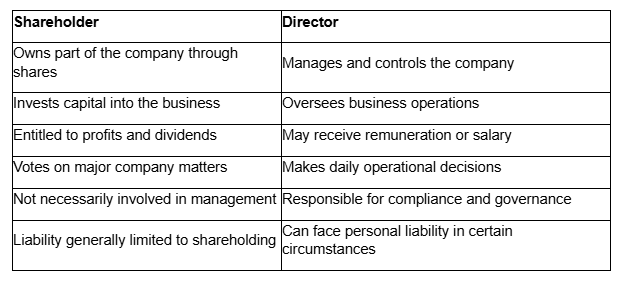
A shareholder is a person or entity that owns shares in a company. By purchasing or holding shares, the shareholder becomes a part-owner of the business. The level of ownership is usually determined by the number or percentage of shares held in the company.
Main rights of Shareholders
Shareholders generally have the right to:
Receive dividends when declared
Vote on important company matters
Appoint or remove directors
Share in the company’s profits and growth
Receive a portion of the remaining assets if the company is liquidated
Shareholders are primarily investors in the company and are not necessarily involved in the day-to-day operations of the business.
What is a Director?
A Director is a person appointed to manage and oversee the operations and affairs of the company. Directors are responsible for making strategic and operational decisions on behalf of the company. A company may have one or multiple directors depending on its structure and requirements.
Main responsibilities of Directors
Managing the company’s operations
Making strategic business decisions
Ensuring legal and regulatory compliance
Maintaining proper financial records
Acting in the best interests of the company
Ensuring the company meets its statutory obligations
Directors owe fiduciary duties to the company and may be held accountable for misconduct, negligence, or non-compliance.
Key differences between Shareholders and Directors
Can a person be both a Shareholder and a Director?
Yes. In many private companies, particularly small businesses, the same person may act as both a shareholder and a director. For example, a business owner may:
Own 100% of the shares in the company, and
Serve as the sole director managing the business
Although one person may hold both roles, the legal distinction between ownership and management still exists.
Why understanding the difference matters
Proper corporate governance
Clearly defining roles and responsibilities promotes accountability and transparency within the business.Legal and regulatory compliance
The Companies and Intellectual Property Commission (CIPC) and the South African Revenue Service (SARS) require companies to maintain accurate information regarding Shareholders and Directors.Decision-making authority
Directors are responsible for operational decisions, while shareholders generally influence major structural decisions through voting rights.Liability and risk management
Directors may face legal consequences for failing to comply with company legislation, tax obligations, or fiduciary responsibilities. Shareholders, on the other hand, usually have limited liability tied to their investment.
Importance of maintaining accurate company records
Companies should ensure that all shareholder and director information is properly maintained and updated. This includes:
Share registers
Director appointments and resignations
Beneficial ownership records
Company resolutions
Annual returns and compliance submissions
Accurate records support compliance and reduce the risk of disputes or penalties.
Conclusion
While Shareholders and Directors are both important to the success of a company, their functions differ significantly. Shareholders are the owners and investors of the business, while Directors are responsible for managing and overseeing company operations. Understanding the distinction between these roles helps businesses maintain proper governance, improve compliance, and operate more effectively. At SPJ Accountants, we assist businesses with company compliance, corporate governance, financial management, and regulatory support to help ensure that businesses remain compliant and well-structured for sustainable growth.